

A Dubai apartment advertised with an attractive rental yield can look very different once the owner starts paying the bills. The rent may be achievable, yet the headline percentage can still leave out costs that matter to the buyer.
For realtors, the useful question is not simply which property has the highest advertised yield. It is how to compare income and costs consistently enough that a client understands what the number means.
 Property Listing Writing Kit
 UAE Buyer and Seller Consultation Kit
Begin by naming the metric, verifying the rental assumption, checking the property’s approved service charges and building a transparent cost schedule. Keep financing separate until the property-level calculation is clear. Then show how the result changes when the assumptions change.
This approach does not predict an investor’s return. It gives the buyer a clearer basis for comparing opportunities and identifying the information still needed.
Agree on what the percentage measures
Table of Contents
Gross rental yield, net rental yield and cash-on-cash return answer different questions. Before comparing two listings, ask the person supplying the figures to show the numerator, denominator and exclusions.
For this article, gross yield means annual rent divided by purchase price. The operating yield used below means rent after the stated vacancy allowance and operating costs, divided by purchase price. Yield on total acquisition cost uses that larger cost base instead.
Cash-on-cash return relates the defined annual cash flow to cash invested. It therefore needs separate financing assumptions where borrowing is involved. None of these simple annual measures captures every aspect of a multi-year investment, such as sale proceeds or changing property value.
Start with a defensible rental assumption
Write down whether the rental figure is the existing contracted rent, a supported estimate for a future letting or an asking rent from another advertisement. Those are different forms of evidence.
For an occupied apartment, review the tenancy documents and relevant renewal position. For a vacant apartment, record the comparable evidence used and explain the differences between units. A furnished apartment, a different view or a materially different size may not support a direct comparison.
Avoid combining today’s asking price with a rental estimate from a different period without disclosure. A calculation can be mathematically correct while its inputs describe situations that never existed together.
Check the official service-charge information
DLD’s Service Charge Index allows customers to inquire about approved service fees for jointly owned property. Its service instructions describe selecting the project, usage and year.
Use those fields deliberately. Confirm the correct building or project, the relevant use and the budget year rather than selecting a familiar name and assuming the result applies.
Preserve the output and identify what it establishes. Then request the unit’s applicable invoice or statement from the authorised party. Where the annual estimate and the unit documentation differ, reconcile the difference before placing one figure in a buyer presentation.
Understand the area basis and the bill
An agent may receive a quoted rate per square foot and multiply it by the area in a listing. Before relying on that calculation, confirm the applicable area and charge components.
Article 25 of Dubai Law No. 6 of 2019 links the owner’s share to the approved calculation method and the unit’s area recorded in the Real Property Register. Article 27 requires RERA approval for the relevant charges.
Do not treat an advertised floor area as a substitute for the underlying records. Ask the management company to explain material discrepancies between the estimate and invoice. Record the answer so another colleague can reproduce the calculation.
Build a cost schedule without double counting
List the operating items expected to affect the owner: service charges, unit maintenance, management, leasing costs, owner-paid utilities or insurance where applicable, and an allowance for periods without rent.
Check which items are already included elsewhere. DLD’s Mollak information describes service-charge components including maintenance, utilities, administration, insurance and reserve charges. An agent should therefore inspect the breakdown before adding a second allowance for the same expense.
Distinguish a budget allowance from a paid invoice. Setting aside money for future repairs is a planning decision; it does not mean that amount was spent last year. Label both clearly and apply the same treatment across comparable properties.
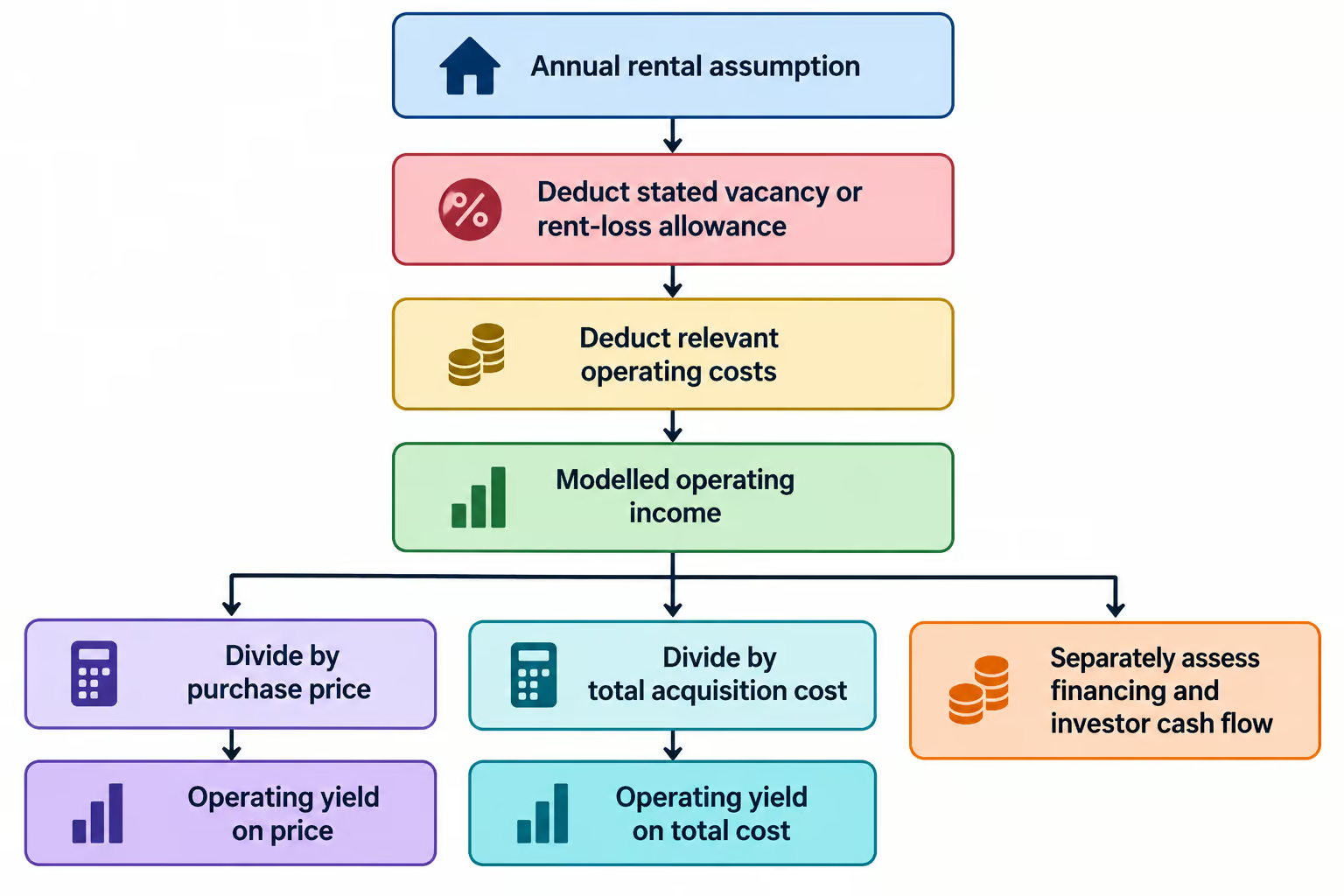
Diagram 1. Explanatory calculation structure used in this article. This is a model framework, not observed market data. The treatment of service charges should be checked against official DLD information.
A teaching example: from headline rent to operating income
Consider a wholly hypothetical apartment costing AED 1,000,000, with assumed annual rent of AED 80,000. These are invented teaching inputs, not a Dubai listing or market estimate.
Assume AED 5,000 for vacancy or rent loss, AED 12,000 in service charges, AED 3,000 for unit maintenance and AED 4,000 in management costs. Total deductions are AED 24,000, leaving AED 56,000 under this simplified model.
The gross yield is 8%. The modelled operating yield on purchase price is 5.6%. If hypothetical acquisition costs add AED 60,000, the same income divided by AED 1,060,000 is approximately 5.28%.
The calculation excludes financing, taxes, capital expenditure and any other cost not listed. Replace every assumption with appropriate evidence before using the structure for a real buyer.
| Hypothetical teaching input or result | Amount |
|---|---|
| Purchase price | AED 1,000,000 |
| Assumed annual rent | AED 80,000 |
| Vacancy or rent-loss allowance | AED 5,000 |
| Service charges | AED 12,000 |
| Unit maintenance allowance | AED 3,000 |
| Management costs | AED 4,000 |
| Modelled operating income | AED 56,000 |
| Hypothetical total acquisition cost | AED 1,060,000 |
All table figures are teaching assumptions or calculations, prepared 29 October 2026. They are not market observations, official fee quotations or investment forecasts.
Explain why the denominator changes the answer
The example produces different percentages without changing the apartment’s assumed income. The difference comes from what is counted as the investment base.
Purchase price is useful for one comparison, while total acquisition cost makes the initial outlay more visible. An existing owner considering today’s value may want another calculation entirely. State which question is being answered.
Do not quietly remove acquisition costs after the first year and present the resulting percentage as improved performance. The property may have earned exactly the same income. Changing the measurement basis should be disclosed separately from any change in the investment itself.
Keep borrowing separate from property performance
A mortgage changes the investor’s cash commitments, but it should not obscure the underlying property’s operating picture. First show the income after the stated operating assumptions. Then add the actual financing terms to a separate cash-flow schedule.
For that schedule, distinguish interest from principal repayment and use the lender’s payment information. Principal repayment consumes cash while also reducing the outstanding debt; it should not disappear from a cash-flow assessment.
Avoid calling a return net without identifying whether mortgage payments, taxes and major replacements are included. Two agents can use that word and describe substantially different amounts. Clear labels are more useful than a confident percentage.
Test assumptions that could change the decision
A single estimate can conceal how sensitive the result is. Ask what happens if the achievable rent is lower, the letting takes longer or an unexpected repair becomes necessary.
Use explicit scenarios rather than claiming to know their probability. For example, changing one assumption in the teaching model can show its effect while leaving the others fixed. A combined downside scenario can then show how several difficulties interact.
Keep the scenarios proportionate to the evidence. A downside case should help the buyer understand exposure, not manufacture fear. An optimistic case should be described as conditional rather than expected simply because it makes the listing attractive.
Compare properties using the same rules
A ranking is only meaningful when its entries use consistent methods. Compare the same rental period, ownership structure and cost treatment, and document any unavoidable differences.
A higher service charge does not automatically make a property inferior. Examine what the charge covers, the building’s condition and the evidence for the rental assumption. Equally, a low charge should not be treated as proof of strong maintenance or low future costs.
Show the client the important differences beside the result. Two apartments with similar modelled yields can have different maintenance demands, tenancy situations and liquidity considerations. A percentage can support that discussion, but it cannot replace it.
Separate recurring costs from transaction adjustments
Before a purchase, distinguish the annual service-charge expectation from unpaid balances, credits and adjustments attached to the transaction. Ask for the relevant statement and the supporting documents.
A recurring annual estimate answers what ownership may cost over time. A balance requiring settlement at transfer is a different cash-flow item. Combining them without explanation can distort both the annual yield and the amount the buyer needs initially.
Have the responsible transaction professional clarify disputed allocations. Do not assume an online annual rate proves that every balance on a particular unit has been cleared. The buyer needs a documented position for the actual transaction.
Review incentives and temporary waivers
A service-charge waiver can affect early cash flow, but the comparison needs to show what happens when it ends. Obtain the written terms, duration, coverage and responsible party.
Present the incentivised period and the later period separately. Do not assume that the waiver covers every charge or that the continuing annual cost will remain unchanged.
The same principle applies to rental guarantees or promised management arrangements. Read the obligations, exclusions and conditions before inserting the advertised amount into the model. A contractual promise should be evaluated as a promise with terms, rather than silently treated as rent already received.
Prepare a buyer summary that can be checked
A useful summary fits the key assumptions and results together. Identify the property, valuation date, price basis, rental evidence, service-charge source, other deductions and the metric being reported.
Mark each input as documented, estimated or unresolved. Include the calculation and explain the material exclusions. Keep the evidence available so the buyer or their adviser can challenge an assumption without rebuilding the entire file.
Update the summary when a material input changes. An older service-charge figure or revised tenancy arrangement can leave a previously accurate comparison out of date. Version the document and make clear which result is current.
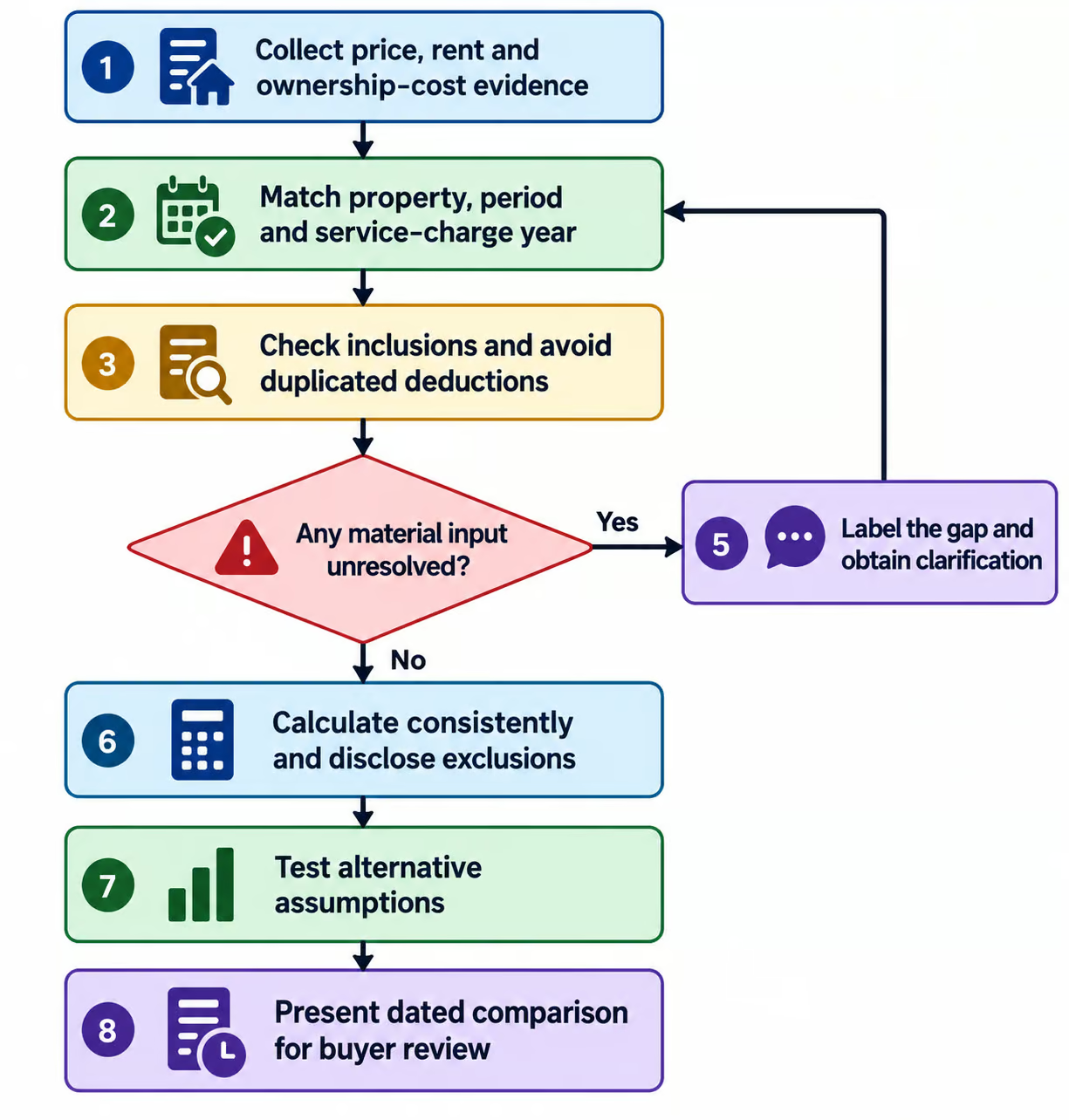
Diagram 2. Recommended comparison workflow. Official charge checks use DLD’s Service Charge Index; the remaining steps are editorial recommendations, not an official investment approval process.
Frequently asked questions
Is rent minus service charges a complete net yield?
It is a limited calculation if other relevant costs are omitted. Describe exactly what was deducted and use a label that makes the exclusions visible.
Can an advertised yield be guaranteed?
A modelled percentage alone does not establish a guarantee. Any separate contractual guarantee requires review of its wording, conditions and the party responsible for performance.
Which service-charge year should I use?
Identify the relevant approved budget and the ownership period being modelled. If the needed budget is unavailable, disclose the older information and the uncertainty rather than presenting it as current.
Can I compare financed and cash purchases directly?
First compare the properties on a consistent basis before financing. Then assess each buyer’s financing and cash commitments separately, using actual terms where available.
What should a realtor do first today?
Take one advertised yield and reconstruct it from the underlying rent, price and cost information. Write down every exclusion. If another person cannot reproduce the number, improve the explanation before using it in a buyer conversation.