

Off-plan sales often move quickly. A buyer likes a floor plan, a salesperson mentions a limited allocation, and a payment request arrives before the buyer has organised the documents. At that point, a realtor’s most useful contribution is a clear verification process.
The question is straightforward: how can an agent check that the project being discussed is the registered project, and that the requested purchase payment is directed to the correct escrow account?
 Client Presentation Templates
 Buy and Hold Property Investing in the UAE
Start with the official project record, match the registered identifiers against the transaction documents, and verify the payment instructions through established channels. Keep unresolved discrepancies visible. A brochure, familiar logo or forwarded bank letter should never be the entire evidence trail.
This guide focuses on Dubai. It explains practical checks and escalation steps, rather than certifying any individual project or payment route.
Understand the account you are checking
Table of Contents
Dubai Law No. 8 of 2007 provides for off-plan purchaser payments to enter an account opened in the project’s name. Article 9 provides that separate projects have separate escrow accounts and restricts each account to its project’s construction.
For an agent, this creates a specific question: does this payment instruction relate to this registered project? A developer’s reputation does not answer that question, and neither does an account associated with another development.
Keep the distinction clear when speaking to buyers. Verifying an account’s relationship to the project is one task. Evaluating construction progress, contract terms and the buyer’s financial commitments involves further checks. Do not describe one successful check as approval of the whole investment.
Verify before promoting, rather than after a reservation
DLD’s brokerage guide instructs brokers marketing off-plan projects to check project licensing, registration and the associated escrow account. It also calls for a marketing contract between the developer and brokerage.
RERA’s circular dated 19 March 2025 addresses developers promoting projects before registration and escrow opening. It identifies that practice as a violation and prohibits collecting project-related payments outside the designated escrow account.
The practical implication is to build verification into project onboarding. Before the sales team receives a launch pack, assign someone to review the supporting records. Commercial urgency should not decide whether a missing document is important. If a necessary confirmation is absent, obtain it before moving the campaign forward.
Begin with the registered project identity
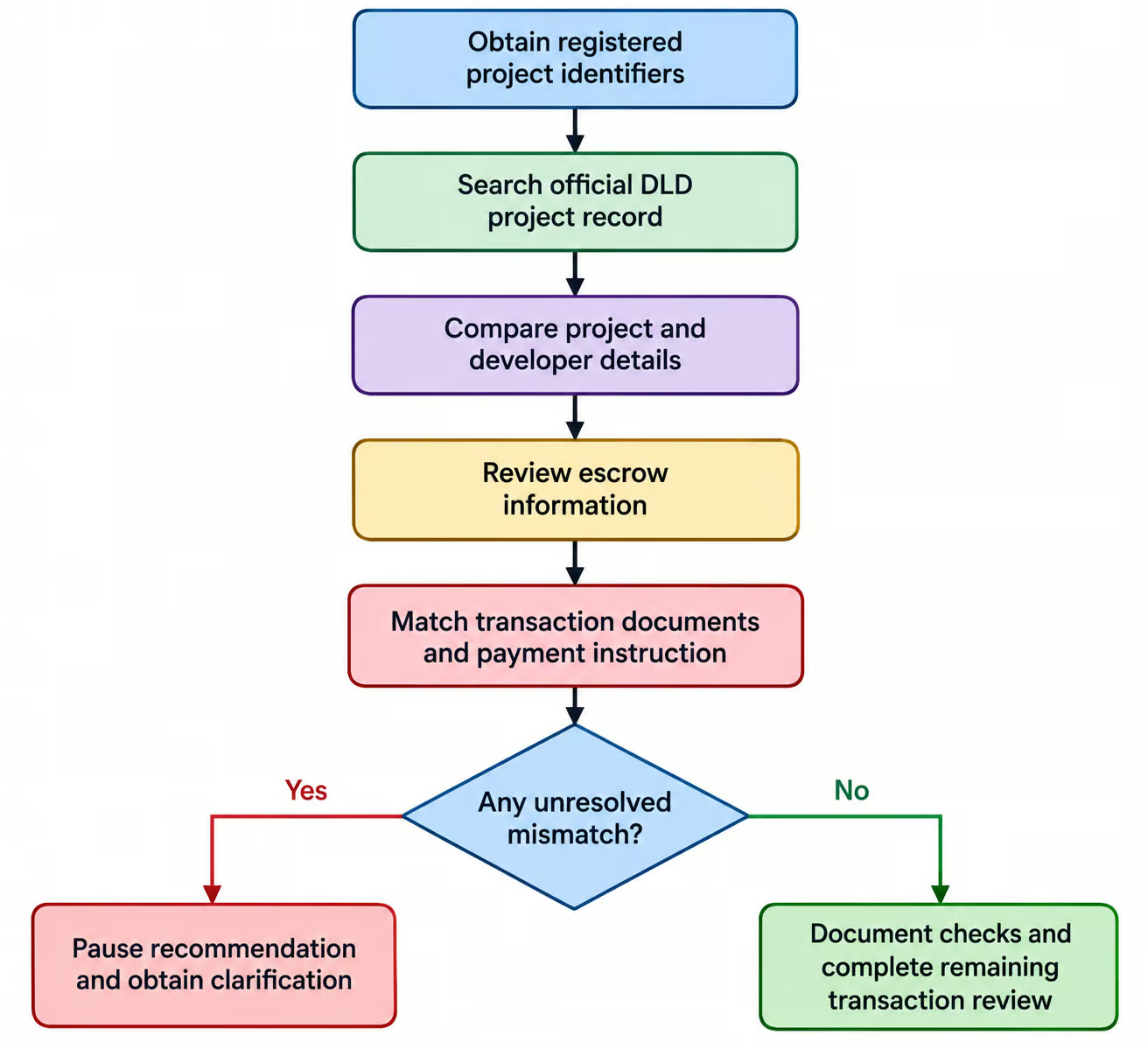
Ask for the registered project name and number, developer identity, and any relevant phase or plot information. Put those details beside the name used in the sales presentation.
DLD’s Project Status Enquiry offers searches by project name, project number or land number. Its interface includes project, inspection, developer and escrow information.
Search using the registered identifiers and preserve the result with the date of your check. Do not treat an unsuccessful search as proof of fraud: first rule out spelling differences and mismatched phases. Equally, do not treat the existence of a similarly named project as confirmation. The identity needs to match the transaction under discussion.
Read what the official record actually establishes
Open the available sections of the official result rather than relying on a screenshot of its heading. Note which details are present, which are missing and whether update information is displayed.
Keep facts separate from conclusions. A recorded project status is a fact you can report with its source and date. A claim that the buyer will receive keys on time is a different statement requiring its own support.
Avoid filling gaps with assumptions. If a field is blank or cannot be accessed, record the limitation and request clarification through the appropriate channel. A clean-looking file with unmarked gaps is less useful than a complete record of what remains unresolved.
Match the payment instruction to the project
Collect the formal payment instruction and compare its bank, beneficiary and account identifiers against the project information and transaction documents. Include the unit reference and the purpose of the payment in the review.
Do not rely on the appearance of a PDF. A document can look professional while referring to an outdated account, another project or a different transaction. The evidence should establish the connection between the buyer’s obligation and the specified destination.
Use a second person to check the comparison before the buyer acts. This is a recommended internal control, not a statement that two reviewers satisfy every legal requirement. The aim is to catch avoidable mismatches while there is still time to resolve them.
Treat changed bank details as a fresh verification
Suppose the buyer receives a new payment instruction shortly before an instalment is due. The message says the previous account is temporarily unavailable and asks for a transfer to a replacement.
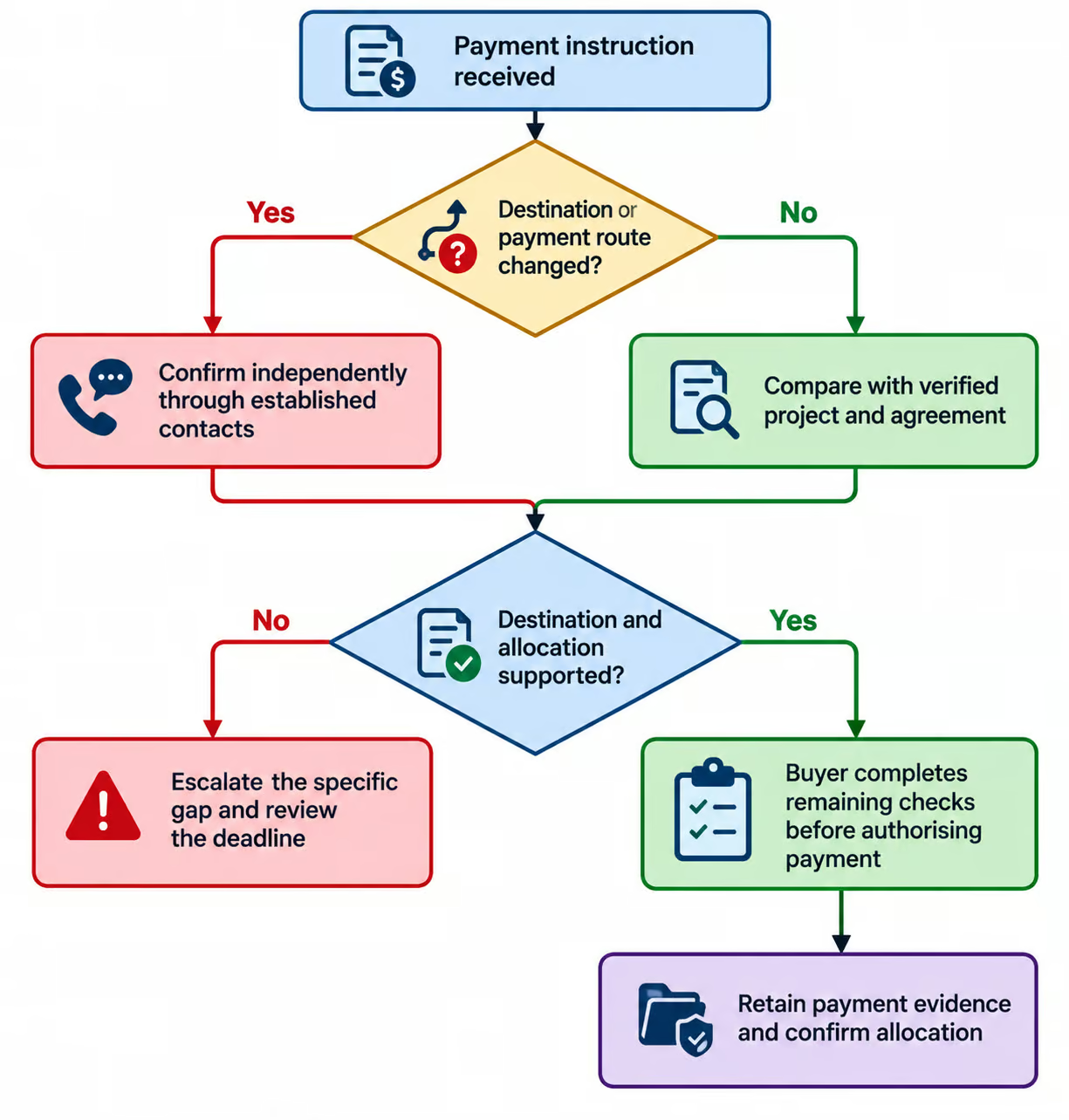
Do not authenticate the change using only the contact details inside that message. Contact the established developer or bank channel independently, provide the registered project reference and request documented confirmation of the correct destination.
Preserve both instructions and the explanation. If the discrepancy is unresolved, escalate it promptly and seek guidance on the payment obligation and deadline. Avoid advising the buyer to ignore contractual commitments; the objective is to resolve the destination safely and obtain appropriate advice where necessary.
Ask specific questions about card-payment links
A public discussion reviewed for this article describes a buyer outside the UAE who was offered a card-payment link and told that funds would pass through a sub-account before reaching escrow. The buyer asked whether a developer receipt was sufficient protection.
That account is an unverified report, not evidence that the described route was approved or unlawful. It does, however, illustrate a useful question for agents: what evidence connects the customer’s payment to the project’s designated account?
For a proposed indirect route, request a written explanation from the developer and appropriate confirmation from the escrow trustee or relevant authority. Ask who initially receives the money, how it is allocated, and what evidence will confirm the project credit. Do not approve the route simply because a payment link works.
Separate payment evidence from project-progress evidence
A receipt helps document a payment, but it does not explain every aspect of construction or contractual performance. Keep the payment record and progress review as distinct parts of the file.
DLD’s FAQ directs users to its project-tracking service to review completion information. It also discusses the purchaser’s right to seek confirmation of progress where a payment schedule depends on construction milestones.
Read the actual payment schedule before comparing a request with progress information. A calendar-based instalment and a milestone-linked instalment are different instructions. If the obligation is disputed, obtain qualified advice about the agreement instead of deciding that a photograph or a single percentage settles the issue.
Explain what escrow does without promising a risk-free purchase
Buyers may hear the word escrow and assume the remaining decision is simple. An agent should avoid turning a regulatory protection into a blanket reassurance.
Explain the verified facts: which project was checked, which account information was compared and which documents support the payment request. Then identify the questions that remain outside that check, such as contractual handover terms, specifications and the buyer’s ability to meet future instalments.
Use restrained language. Saying that account details matched the official record on a particular date is more precise than saying the project is completely safe. The first statement describes evidence; the second promises much more than the check establishes.
Handle expressions of interest with clear questions
An expression of interest can feel less significant than a sale agreement, especially when the amount is described as refundable. Buyers still need to understand what they are being asked to sign and pay.
Request the written terms, the recipient, the purpose of the amount, the allocation process and the refund conditions. Check whether the project registration and payment arrangements have been verified. Do not assume that the label attached to a payment creates an exemption.
If a salesperson says the escrow account will be opened later, escalate the issue before recommending payment. Any asserted exception should be supported by applicable authoritative confirmation, rather than a claim that the arrangement is common practice.
Give overseas buyers a document trail they can use
Distance makes a structured file especially valuable. An overseas buyer may be receiving sales messages across time zones while their bank requests information about the transfer.
Prepare a concise record linking the registered project identity, relevant agreement, verified payment instruction and communication history. Mark the date of each check and name the person responsible for the next action.
Help the buyer ask their bank about transfer references and documentation requirements through its own official channels. Do not offer personal accounts or informal intermediaries as a shortcut. If a route cannot be verified, identify the exact unresolved question so the appropriate party can answer it.
Keep the process consistent across the brokerage
A dependable process should survive staff leave, busy launches and handovers between agents. Use a shared checklist and a controlled location for the documents, with access limited to the people who need them.
Record approvals by reference to the version reviewed. A file marked checked is ambiguous if the payment instruction changes afterwards. Reopen the relevant check whenever the underlying information changes.
Review a small sample of files internally to identify recurring problems. If project names are frequently mismatched, improve onboarding. If changed instructions arrive through informal messages, strengthen the confirmation process. Use the findings to repair the workflow rather than relying on reminders to be more careful.
Frequently asked questions
Is a developer’s trade licence enough?
DLD’s brokerage guidance calls for project-level checks, including registration and escrow, alongside the marketing relationship. A company document does not replace those project-specific checks.
What if the project does not appear in the search?
Confirm its registered name, number and phase with the developer, then try the appropriate official search again. If it remains unresolved, seek clarification before treating the project as verified.
Does an official receipt prove every payment requirement was satisfied?
Do not make that assumption. Compare the receipt with the obligation and verified account information, and request clarification where the credit or allocation remains unclear.
Can I use this checklist for another emirate?
Use the relevant local authority and legal framework. This article addresses Dubai; a similar project name or familiar developer does not make Dubai’s procedures applicable elsewhere.
What is the best first action for an agent?
Choose one project you currently represent. Match its registered identity, payment instruction and marketing documents, then write down anything you cannot verify. Resolve those gaps before presenting the next buyer with a payment request.