

A buyer agrees a price, receives encouraging mortgage feedback and starts preparing for transfer. Then the bank’s valuation arrives below the agreed amount. The immediate question is usually whether the seller will reduce the price. The more urgent question is how much cash the buyer now needs.
For Dubai realtors, this is a transaction-planning problem as well as a negotiation issue. The purchase price, the lender’s accepted property value, the approved loan and the completion deadline need to be considered together.
 UAE Buyer and Seller Consultation Kit
 Real Estate Agency Operations Manual
The practical response is to obtain the bank’s confirmed position, recalculate the buyer’s contribution and costs, and review the signed agreement before advising either party about the next step. A lower valuation does not, by itself, establish a contractual right to cancel or recover a deposit.
Separate four figures that are often confused
Table of Contents
Write down the agreed purchase price, the valuation, the lender’s accepted financing basis and the actual approved loan amount. They may be related, but they are not interchangeable.
An asking price is the seller’s starting position. An agreed price records what the parties have negotiated. A valuation serves a particular purpose and date. The loan amount also depends on the lender’s assessment and conditions.
Emirates NBD’s Key Facts Statement describes valuation as an independent assessment of the property’s market value. It also directs customers to the final loan terms rather than treating its indicative product information as a personalised approval.
The agent’s role is to make the distinctions visible, then ask the lender which figures govern this application.
Do not turn an advertised maximum into a promise
Emirates NBD’s published statement advertises loan-to-value ratios of up to 85% for UAE nationals and 80% for expatriates. The words up to matter: these are product ceilings in the published information, not a commitment to every applicant or property.
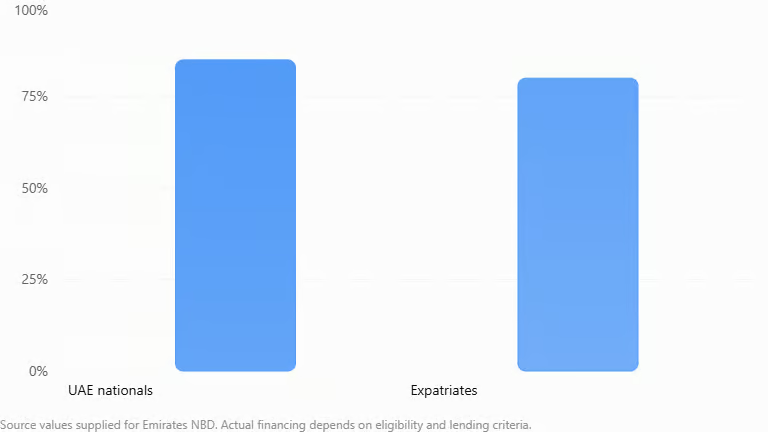
Graph 1. Published product maxima, checked 30 October 2026. Eligibility, property category, valuation and final approval conditions apply. These are not average loans granted or personalised offers. Source.
Ask the lender or mortgage adviser to confirm the buyer’s applicable category, approved amount, valuation treatment and outstanding conditions. An agent should not select the most generous percentage from a website and build the buyer’s budget around it.
Keep the confirmation in the transaction record. When the property or financing details change, ask whether the earlier position still applies. A previous conversation about affordability is not a substitute for the current application decision.
Show the cash effect with a transparent example
Consider a hypothetical completed apartment with an agreed price of AED 2,000,000. Assume the lender would provide 80% of an accepted value equal to that price. The loan would be AED 1,600,000, leaving AED 400,000 toward the price from the buyer.
Now assume the lender accepts a valuation of AED 1,850,000 and applies the same 80% financing ratio. The loan becomes AED 1,480,000. If the price remains unchanged, the buyer must provide AED 520,000 toward it.
The additional cash is AED 120,000. In this example it equals 80% of the AED 150,000 valuation difference.
These are teaching assumptions, not a lender quotation. Both calculations exclude acquisition costs and assume no other lending limit changes. Use the bank’s actual approved amount when assessing a real transaction.
| Hypothetical teaching example | Initial assumption | Lower valuation |
|---|---|---|
| Agreed purchase price | AED 2,000,000 | AED 2,000,000 |
| Accepted financing value | AED 2,000,000 | AED 1,850,000 |
| Assumed financing ratio | 80% | 80% |
| Calculated loan | AED 1,600,000 | AED 1,480,000 |
| Buyer contribution toward price | AED 400,000 | AED 520,000 |
Illustrative calculations prepared 30 October 2026. Excludes fees and other costs; not an actual transaction or lending decision.
Rebuild the complete cash requirement
The extra contribution toward the price is only part of the picture. Prepare an itemised completion budget including applicable registration charges, trustee costs, lender charges, professional fees and any transaction adjustments.
DLD’s Property Sale Registration service lists seller and purchaser percentage fees. Confirm the applicable allocation and transaction requirements rather than assuming that one informal percentage covers everything.
DLD separately publishes a mortgage registration charge of 0.25% of the mortgage value, alongside other applicable charges. That percentage uses the mortgage amount as its base.
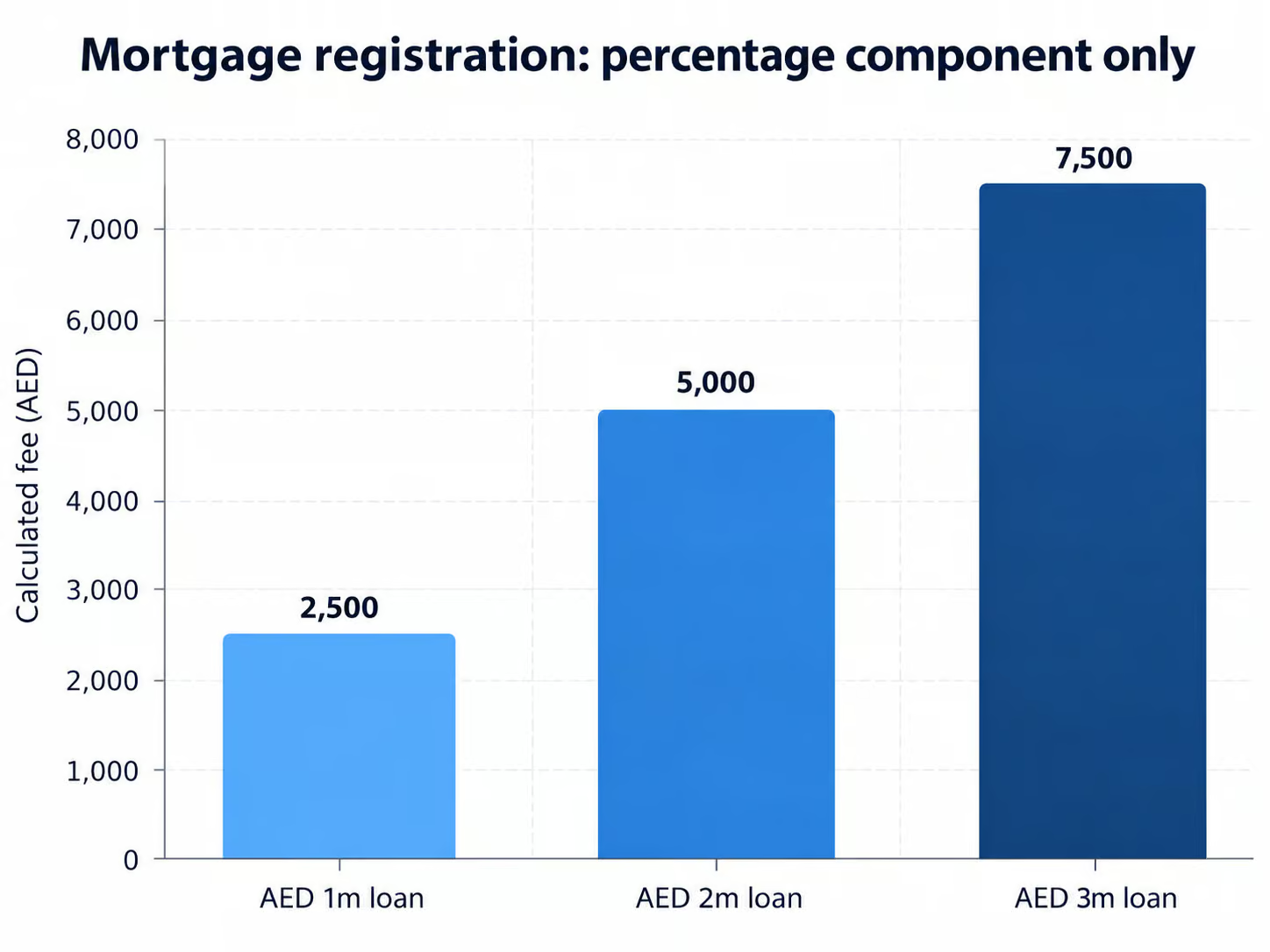
Graph 2. Calculated examples using DLD’s published 0.25% rate, checked 30 October 2026. Loan sizes are illustrative. Excludes title-deed, service-partner and other applicable charges; this is not a total completion-cost quotation. Source.
Show which amounts are estimates, which have been quoted and when payment is needed. A buyer can have sufficient wealth overall but still lack accessible funds at the required time. That timing issue belongs in the completion plan.
Check the contract before discussing cancellation
Ask for the signed Form F, relevant addenda and later written variations. Identify the financing provisions, valuation wording, deadlines, notice requirements and deposit arrangements.
Do not assume a generic phrase about mortgage approval answers every question. The wording may distinguish between refusal of finance, a smaller approved loan and an unacceptable valuation. It may also specify steps the buyer must take.
Have a qualified transaction adviser or lawyer review any disputed interpretation. The agent can organise the facts and communicate proposals without declaring that a deposit is automatically refundable or forfeited. Those conclusions require the actual agreement and circumstances.
Give the seller evidence rather than a demand
A valuation shortfall can support a conversation, but it does not force the seller to accept a different price. Present the confirmed financing effect and ask whether a revised commercial arrangement is possible.
Prepare the proposal clearly: what price is requested, what evidence supports the request, whether the buyer can complete at that price and what timetable is achievable. Share valuation material only where authorised.
Avoid telling the seller that the bank has established the only possible market price. Likewise, avoid telling the buyer that the seller must close the gap. The objective is to find out whether an agreement can still be reached and documented.
Ask about a valuation review through the lender
If the buyer believes there is a factual error, ask the lender whether it offers a review and what evidence it will consider. Possible questions concern the recorded unit details, condition or relevant comparable evidence.
Follow the bank’s process. Do not promise that a privately commissioned report will replace its valuation or that a second application will produce a higher figure.
Before pursuing another route, identify the cost, likely timing, impact on the agreement and whether the current valuation remains relevant. A review may be useful, but it should not become an excuse to miss a contractual deadline while everyone waits for a preferred answer.
Treat extra cash as a decision, not an instruction
A buyer may be able to cover the difference from their own available funds. That does not mean the agent should simply tell them to proceed.
Ask whether the buyer has reviewed the revised total outlay and remaining liquidity with their financial adviser where appropriate. The question is whether the transaction still suits their circumstances after the change.
Any proposed source of additional funds should be disclosed to the lender and assessed through its requirements. Do not suggest hiding a new liability or using an informal arrangement to make the application appear unchanged. The financing decision needs accurate information.
Keep negotiation and lender updates connected
If the seller agrees to reduce the price, send the revised position to the lender and transaction professionals. Do not assume the loan will remain exactly as previously calculated.
The bank may need updated documents or a new assessment of the agreed terms. Ask for the resulting loan amount and conditions, then update the buyer’s cash schedule.
Document any contractual variation properly. A friendly message expressing willingness to discuss a discount is different from a completed amendment. Keep the parties clear about what has been proposed, what has been accepted and what still requires confirmation.
Plan the timetable before it becomes urgent
Build the valuation and financing stages into the transaction calendar. Assign responsibility for obtaining property documents, arranging access, following up the report and reviewing the lender’s response.
Track the agreement’s dates separately from internal target dates. If a delay threatens completion, communicate early and seek any necessary extension through the proper process.
Avoid backdating records or treating silence as consent. A transparent timeline helps the seller understand why an extension is requested and helps the buyer see which action is blocking progress. It also reduces the risk that different advisers are working toward different assumed deadlines.
Prepare the seller’s mortgage side separately
Where the property is already mortgaged, the sale may involve an additional bank process. DLD publishes a specific service for registering the sale of a mortgaged property, including the release documentation needed to complete the relevant procedures.
Establish who is coordinating that part of the transaction and which documents or payments are required. Do not treat the buyer’s mortgage approval as confirmation that the seller’s bank requirements are resolved.
Bring the two workstreams together in the completion plan. A revised buyer loan can affect available funds, while the seller’s release process can affect timing. Both need current information before a transfer appointment is treated as ready.
Keep a decision record that another person can follow
Summarise the price, valuation, confirmed loan, buyer contribution, costs, outstanding conditions and next deadline in one dated record. Link each figure to its source.
If several options are being discussed, show them separately. A price reduction, valuation review and different financing application may have different costs and dependencies. Do not combine their most optimistic features into one assumed outcome.
Record the client’s instruction after they have received the relevant information. Clear documentation protects the quality of the service: it allows the team to explain what changed and what was known when the decision was made.
Frequently asked questions
Does a lower valuation mean the property is definitely overpriced?
It shows a difference between the agreed price and a valuation for a particular purpose and date. Assess the evidence and relevant circumstances rather than treating one figure as a universal conclusion.
Will the buyer always need to fund the entire valuation difference?
Not necessarily. In the teaching example, the additional cash is the financing percentage multiplied by the valuation difference. The actual effect depends on the lender’s approved amount and any other constraints.
Can the buyer cancel automatically?
Do not assume so. Review the signed agreement, addenda, applicable conditions and facts with a qualified adviser before deciding the position.
Does moving to another bank guarantee a better result?
No. Ask about eligibility, valuation policy, costs and timing before relying on another application. A different lender may reach the same or a lower financing amount.
What should a realtor do first today?
Take one financed purchase and check that its cash budget uses a confirmed loan amount rather than an advertised maximum. Then identify the valuation dependency and the contractual deadline. Resolve those gaps before describing the transaction as ready to complete.